

 Back

 19
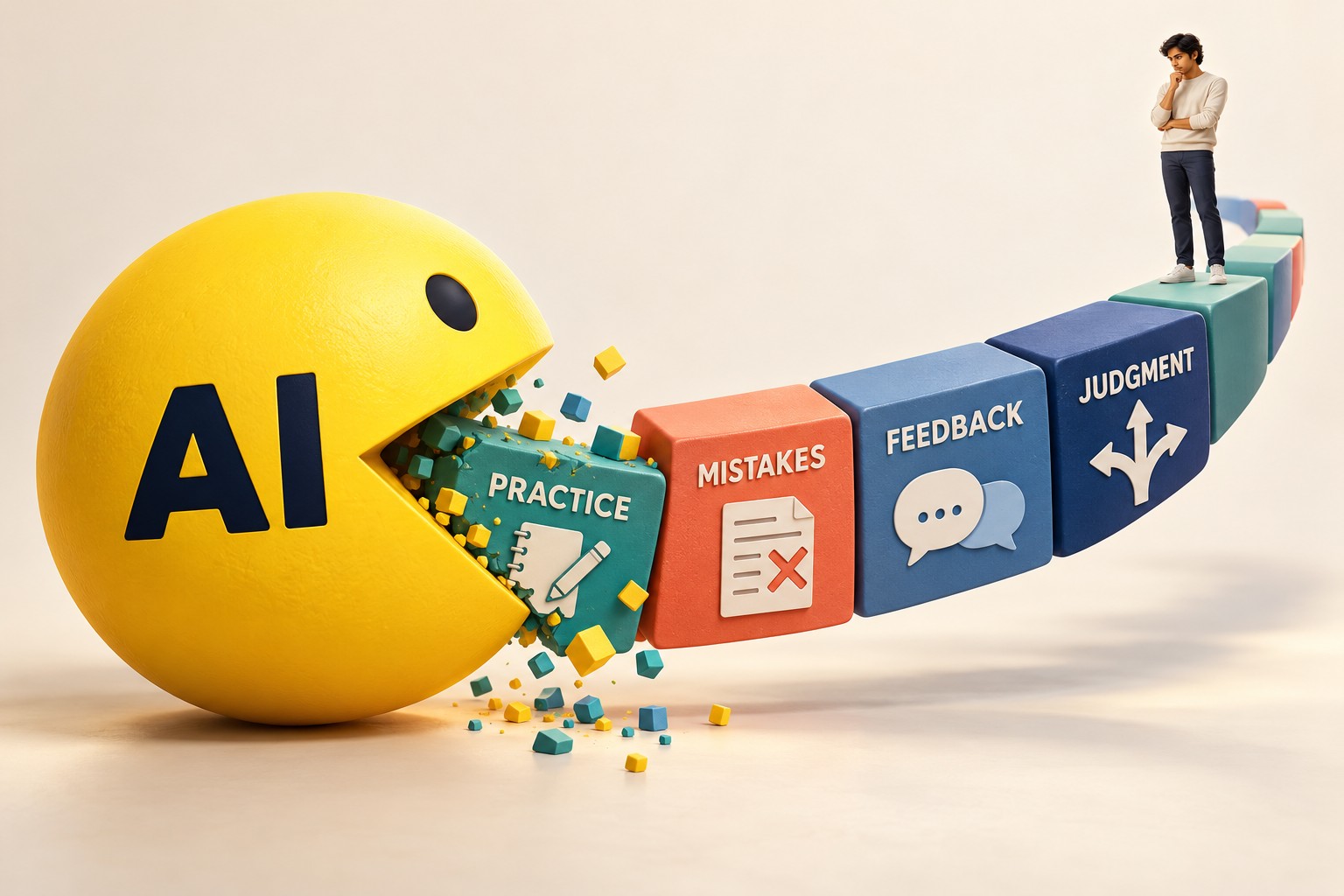
Our view is simple. For most Indian professionals, AI will not generate a pink slip. It will arrive as a higher standard of work, and a challenge for freshers and juniors. The first thing at risk will not be your job. It will be your learning curve: the practice, mistakes and feedback that turn a fresher or a junior into someone worth retaining and promoting.
The World Bank’s World Development Report 2026: The Promise of Artificial Intelligence (https://www.worldbank.org/en/publication/wdr2026) offers a context for the present-day debate on AI and careers. It estimates that generative AI could automate about 4.5% of jobs in low- and middle-income countries and could complement another 16.2%.
These figures describe exposure for a group of countries, not job losses, and they are not specific to India. But the report also notes that in India, monthly postings for white-collar roles vulnerable to AI have fallen, with entry-level workers affected disproportionately. For South Asia as a whole, it puts the fall in listings for the most exposed white-collar occupations at about 20%. It also warns that workers who hand demanding thinking to AI may slowly forget, or never learn, how to do it.
Why do these statistics matter for your career? Fewer entry-level roles means fewer chances to learn on the job, and relying on AI for the thinking removes more of them.
No data measures that damage, so this is our judgment. What follows is our interpretation of what it means for your skills, your choices and your growth at work. These are LAPRO’s opinions, not the World Bank’s.
The short version
• The pressure lands first on entry-level, routine white-collar work. If your job is mostly processing, you are more exposed.
• Your learning curve is the first thing at risk. Using AI to do your thinking costs you the practice that builds capability and future employability.
• Employers who replace juniors with AI may be cutting their own future leadership. And cheaper tokens don’t mean cheaper AI.
• Local knowledge is a real edge. AI misses context that Indian professionals notice.
• Don’t wait for your employer to make you AI-ready.Visibility turns skill into progress
Entry-level, routine work is where AI bites first
The World Bank’s estimate that 4.5% of jobs in low- and middle-income countries could be automated by generative AI.
The report flags sectors with the highest automation potential, such as information technology, finance and business services. And this is where many Indian graduates start their careers. The report points to evidence of reduced white-collar postings in India, with a disproportionate effect on entry-level hiring.
In our view, that is the early signal. Routine processing is where AI is strongest, and the first rung of the career ladder often has more routine processing roles.
If you work in these areas, audit your role:
• What do I add that a machine cannot?
• How much of my week is routine processing? That is where you are replaceable.
• Can I show my output in metrics that the organization values?
Then focus on the work at AI or machines handle poorly. Look for roles that demand situational awareness, dealing with multiple people and organizations, demanding abstract and non-linear thinking, and physical presence that an AI cannot provide.
Your risk of being replaced by AI depends on how clearly you can demonstrate that you cannot be compared to a machine.
AI can accelerate your performance. But outsourcing your thinking to AI may quickly end your career.
AI helps professionals produce work that earlier may have taken more experience and knowledge. It becomes especially valuable for juniors without much real-world exposure. Now they can do stuff that would have required more exposure. We think that over-reliance on AI is also the trap.
Early in your career, hands-on work, trial and error, and feedback are how you learn. Here are a few examples:
• You prepare a report, your seniors give you feedback, and you learn what matters.
• You send a sensitive email to a customer and experience their response. That tells you whether you understood the problem and we dealing with it the right way.
• You do your own drafting and learn the nuances of language and sentiment AI misses.
• You debug code yourself and develop the ability to diagnose what went wrong.
The World Bank report raises a related concern, noting that workers who transfer complex cognitive tasks to AI may slowly forget, or never learn, how to do them. Our conclusion goes further: a junior who lets AI do the core thinking is skipping the training and learning curve that makes them promotable.
So, take AI’s benefits but keep the thinking. One habit helps: ask AI for hints, challenges and counter-arguments rather than finished answers. Write your own first draft, then use AI to sharpen it.
For leaders: replacing juniors with AI can hollow out your pipeline. And cheaper tokens don’t mean cheaper AI.
The report cautions that organizations can become over-reliant on AI, both by delegating so much that they lose control and by under-investing in on-the-job learning. We think that applies directly to entry-level hiring. In our view the report’s concern about organizational capacity includes managerial skills.
Replace most of your juniors with AI and you will have fewer people who learned on the job. Where will your next line of competent leaders come from? You can’t expect someone with two years of AI-dependent experience and little contact with real human situations, to handle complex problems as they grow. A shallow talent pool also limits your choices when you have a crisis or when you need to grow fast.
Then there is the cost story. Per-token prices have fallen steeply, but company AI bills have not. Ramp’s billing data shows token usage grew 1,001% between January 2025 and April 2026 while spend grew 497%. (https://tinyurl.com/ch7kxa7n)
Multiple global company leads at Uber, Nvidia etc. are reporting that AI costs have exceeded the cost of humans they replace or support (https://tinyurl.com/y3pk3hw3)
The ubiquity of Agentic AI means that Agents use many times more tokens per task than a chatbot. (https://tinyurl.com/mrbseesr). And most companies are relying on Multiple AI tools and products as no one system can deal with the emergent challenges and opportunities. All these deployments and experiments tend to further increase spends.
While many of these challenges may be at a high level, the increasing cost of data centers and compute power will rebalance the priorities when it comes to hiring vs AI. This process is ongoing and it will be impossible to predict a steady trend.
What this means for leaders is this- There is no prescriptive model. You will have to balance current needs against the capability required in five years. And be very sure before you cut entry-level roles, so that two years down the line you don’t have a cost-performance imbalance, due to over deployment of AI and gutting of human roles.
Build AI skills around the work you actually do
With new tools launching daily, feeling overwhelmed is natural. Our advice is to stop chasing tools and start with one recurring problem in your current role. And then use a reasonable AI tool to work on that problem. Focus on problem and not the tool.
Here are a few examples-
• Sales: Account Management- Use AI to research an account, then verify it against the customer’s needs in later conversations and other market evidence.
• Finance: Cash flow prediction-Build predictive models with AI, check actual outcomes, investigate the variances, and use the learning to improve the next iteration.
• HR: Hiring efficiency – Use AI to organize interview evidence against agreed criteria, while keeping personal responsibility for the actual assessments and interviews.
Use AI for complex calculations, to argue the other side of your reasoning, or to improve your own draft. But form your own view before accepting its output. Could you explain the results of an AI analysis to your manager or customer without the chat open? If not, you haven’t learnt the work yourself.
Better understanding is the goal, not replacing your thinking. You will be valuable if you are still the person who finds the gaps, opportunities and insights.
Local knowledge is a source of value, and a real advantage for Indian professionals
The World Bank report describes AI as sensitive to context. We take that input to emphasize that a tool that works in one country can fail in another unless it is adapted to local languages, institutions and ways of working. That makes professionals who can spot localization gaps, and adjust the workflow, more useful.
India makes a strong case for local expertise trumping generic global AI:
• An AI-built Diwali marketing plan, with no human intelligence, can miss cultural nuance, including regions that don’t celebrate it in the same way.
• A generic sales recommendation can overlook how floods or drought affect demand in a specific region, in a country of continental scale.
• AI support for local languages is still limited, which leaves gaps a human who knows the language can fill.
In these gaps, human judgment wins. That means you!
Your company’s AI maturity affects you. Don’t let it set your ceiling.
AI adoption and its benefits are uneven. For context, the World Bank’s enterprise survey, which includes India, links adoption to firm characteristics such as management capability and a record of innovation.
India adds a practical twist. Many firms use AI tools without the systems or skills to build them into daily workflows.
A CII–ISB study found 65.8% of surveyed MSMEs use AI tools, but only 21% use ERP or customized business software. The study notes its survey was voluntary and not representative of all Indian MSMEs. (https://shorturl.at/jAJcf)
A separate PayNearby survey of 10,000 small business owners found only 7 % are exploring use of AI tools. (https://sl1nk.com/vspx7ve)
What we are saying therefore, is that you should not be depending on your organization or department to start using AI. Yes, you may not have the funds or skills to interpedently apply AI in your organization or be able to influence workflows. But you should at least try and build some competence independently.
And if you are planning a job change then assess the new organization’s AI readiness before you accept.
Either way, don’t depend on your organization to make you AI-ready.
AI or not, make your contribution visible
Efficiency through AI is great. But career progress requires others to understand the value of your contribution.
Learning AI doesn’t guarantee a promotion or higher pay. Those outcomes depend on business conditions, available roles and how your performance is assessed. If you’re in an entry-level role built on routine processing, you will need to demonstrate your personal value: show results in numbers, to the people who assess you.
The final takeaway
In our view, AI will change the standard of work faster than it removes jobs. The people who fall behind will be the ones who stopped learning along the way. So, protect your learning curve:
• Do original thinking and first drafts yourself. Then use AI to challenge it.
• Get better at one useful part of your job that doesn’t depend on a machine. Training yourself to reach that goal.
• Run the self-test before you implement AI output. If you can’t explain an AI output without referring to it and without verifying its authenticity, you are vulnerable.
• Practice on approved tools, with information your employer permits you to use. If not, learn in private.
The LA-PRO Bottom Line: Tools will keep changing. A learning curve you protected keeps paying off.
Sources and editorial note
This article is LA-PRO’s own analysis. The World Bank’s World Development Report 2026: The Promise of Artificial Intelligence (CC BY 3.0 IGO) -World Bank. 2026. World Development Report 2026: The Promise of Artificial Intelligence. World Bank. doi:10.1596/978-1-4648-2331-2. License: Creative Commons Attribution CC BY 3.0 IGO ; and other sources, are used as context and is not the basis of our views. The interpretations, opinions and recommendations are LA-PRO’s and are not endorsed by the World Bank.